

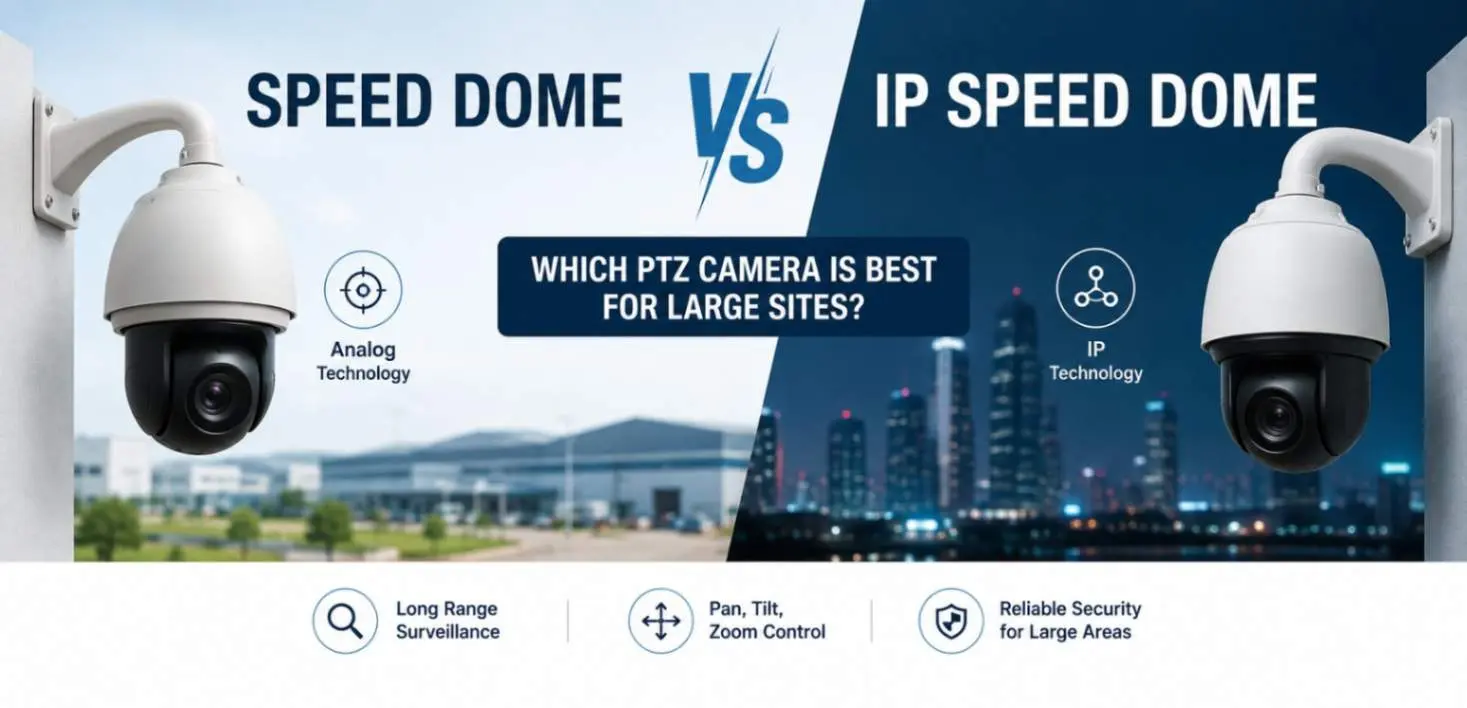
Large sites require specialized CCTV cameras with wider area coverage and featuring detailed images for long distances. This is where PTZ cameras such as speed dome and IP speed dome cameras are considered the most popular options. Both devices offer pan-tilt-zoom for enhanced surveillance, but they have different installation requirements, connectivity, system compatibility, and expansion capability.
Selecting a speed dome or IP speed dome requires careful consideration of various factors, including the installation environment. Most commonly, these PTZ cameras are sourced for large sites including airports, hospitals, corporate offices, IT parks, warehouses, and other commercial spaces. However, choosing a single option may confuse you. This guide explains the exact difference between speed dome and IP speed dome cameras and which one you should choose for a large site.
Before diving deep into the topic we need to understand what a speed dome and IP speed dome camera is.
Read: What is PTZ Camera?
What is a Speed Dome Camera?
A speed dome camera is a motorized PTZ or Pan-Tilt-Zoom camera that can move horizontally and vertically while providing optical zoom for monitoring distant objects. Operators can control the camera remotely, move it between different areas, and configure preset positions for frequently monitored locations.
Speed dome cameras are particularly useful where a single camera needs to observe multiple areas. Depending on the model, features can include high-speed pan and tilt, preset positions, patrol functions, day/night imaging, infrared illumination, and high optical zoom.
What Is an IP Speed Dome Camera?
An IP speed dome is a network-based PTZ camera that transmits video and control data over an ethernet network. Instead of relying on traditional coaxial infrastructure, it can connect to network switches, NVRs, and video management systems.
For new surveillance projects, IP speed domes can provide greater flexibility because cameras can be integrated into an existing or newly designed network infrastructure.
Speed Dome vs IP Speed Dome: Key Differences
| Factor | Speed Dome | IP Speed Dome |
| Video Transmission | Coaxial/HD-over-coax, depending on model | Ethernet/IP network |
| Recording | Generally DVR-based | Generally NVR/VMS-based |
| Cabling | Coaxial cable | Network cable |
| Scalability | Suitable for existing systems | Strong option for scalable IP systems |
| Integration | Depends on the connected system | Broad network and VMS integration |
| Existing Infrastructure | Advantage when coax is already installed | Advantage when network infrastructure exists |
| Advanced Features | Model dependent | Often offers extensive network-based features |
| Best Fit | Upgrades and existing CCTV systems | New and network-centric installations |
So What Should You Choose: Speed Dome or IP Speed Dome?
The right choice between a speed dome and IP speed dome camera should be based on these three essential factors: the project site’s infrastructure, security requirements, and scalability.
You can choose a speed dome:
When you need a traditional surveillance camera and your site already has a coaxial surveillance network and uses a DVR system. In this setup, you can save a lot of money on initial investment and cable installations.
A speed dome is also preferred for small spaces requiring a limited number of devices for surveillance. You don’t need complex network integrations and remote system management; just recording the events is enough.
You can choose an IP speed dome:
For large sites that require advanced surveillance with network access and higher scalability. IP devices require fewer cable installations, with wireless or PoE connectivity. They can be used to establish a centralized monitoring system, allowing you to investigate events across multiple buildings or complexes from a single location. In addition, IP surveillance systems also offer AI-based features and remote management for enhanced security.
Applications of Speed Dome and IP Speed Dome Cameras
Speed dome and IP speed dome cameras can be used across various large-scale environments, including:
- Airports: Terminals, parking areas, and perimeters
- Factories: Production areas and external premises
- Warehouses: Loading bays, storage yards, and entrances
- Parking Lots: Vehicle movement and large open spaces
- Educational Campuses: Buildings, gates, and common areas
- Stadiums: Crowds, entrances, and surrounding areas
- Construction Sites: Equipment and perimeter monitoring
- Industrial Facilities: Critical areas and site boundaries
- Smart City Projects: Roads, intersections, and public spaces
A Quick Checklist for System Integrators While Procuring a PTZ Camera
- Resolution and sensor size
- Optical zoom level
- Pan/tilt range and speed
- Preset and patrol functions
- IR range and low-light performance
- WDR and image quality
- IP/IK protection rating
- PoE and power requirements
- ONVIF and NVR/VMS compatibility
- Analytics and auto-tracking
FAQs
Are IP speed dome cameras better than speed dome cameras?
IP speed dome cameras are ideal for large sites with robust surveillance systems with network integration and remote management using an NVR. Speed dome cameras are best for existing DVR systems that require a limited number of camera devices without advanced surveillance features.
Can an IP Speed Dome work with an NVR?
Yes, IP PTZ cameras are compatible with NVR systems, but they require the right network protocols. They can transmit the data via a network connection to the NVRs for safe processing and storage.
What is the main advantage of an IP Speed Dome?
IP speed dome cameras can transmit video footage over a network connection and are easy to install. They offer a centralized monitoring system to cover large spaces with multiple zones and allow remote management.
What should I check before buying a PTZ camera for a large site?
To buy a PTZ camera for large sites you must consider these factors: optical zoom, low-light performance, WDR, IR range, PTZ speed, network/power requirements, environmental rating, VMS compatibility, analytics and total installation cost.