



Having a reliable fire safety system is essential for every residential, commercial, and industrial space, with best detection technology. However, emergency response can only be effective when the exact location of the activated detector is displayed by the system. Quick fire detection and alarm activation are the initial response; controlling the fire and saving lives comes next after the arrival of emergency response teams. In this situation, identifying which detector signaled the fire breakout helps to save valuable time and lives.
This is where a response indicator comes into play. Also called a remote indicator or LED indicator, it is a visible LED assigned to each detector to show the activation status at an accessible location such as a central panel. These devices are designed by top brands like GST and Honeywell for concealed detectors. This blog reveals what response indicators are and why fire alarm circuits need them.
What is a Response Indicator in a Fire Alarm System?
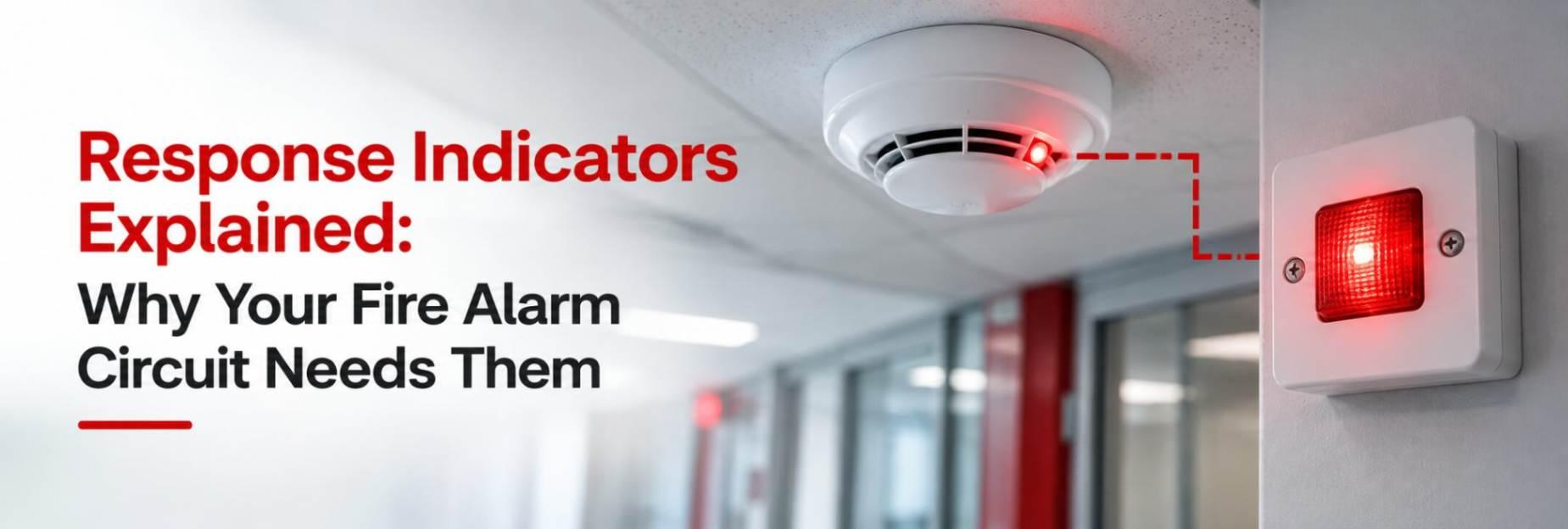
A response indicator is a visual indication device with bright LED light. It activates when a detector has triggered an alarm after detecting the presence of a fire breakout. Each indicator represents a detector and all are located at a central place for easy access.
Response indicators are majorly used when the detectors are concealed because of:
- False ceilings
- Raised floors
- Roof and ceiling voids
- Lift shafts
- Locked rooms
- Service spaces
- Other concealed locations
How Do Response Indicators Work?
A straightforward explanation of the working of response indicators is:
When the detectors sense the presence of fire through smoke detection or a rapid change in temperature, the control panel receives the signal and alarms are activated. The activation signal travels to the response indicators, and their LED lights are illuminated. All the indicators are installed at a central and easily accessible location. Based on the system design, they are either connected to the detector or its base. However, addressable remote indicators can be connected directly to the fire alarm loop and monitor one or multiple detectors after proper configuration.
Detectors sense fire > signal is sent to control panel > alarms are activated > response indicators receive signal > LED lights are illuminated.
Why Does a Fire Alarm Circuit Need a Response Indicator?
A response indicator is connected to the fire alarm system for visible communication about the activated detector. Its sole purpose is to provide quick indication for emergency response teams to locate detectors and suppress the fire before it becomes uncontrollable.
Here’s the manual process for checking a detector:
Without a response indicator: Reach the alarm area > Search for the detector > Find the concealed detector > Confirm the alarm.
With response indicator: Reach the area > See the illuminated indicator > Identify the associated detector.
Key Benefits of Using Response Indicators
- Faster detector identification: Bright LED light helps identify active status quickly.
- Easier emergency response: The indication makes it easy to locate the triggered detector.
- Better visibility of concealed detectors: No need to manually check detectors.
- Less time spent searching: Exact location is tracked using a panel.
- Easier maintenance and troubleshooting: Both active status and location are shown automatically.
Where Response Indicators are Mainly Used?
| Application | Why Response Indicators Are Used |
| False ceilings | • Detector is concealed• Provides visible alarm indication |
| Raised floors | • Detector is below floor• Identifies alarm location quickly |
| Locked rooms | • Detector is inaccessible• Indicator can be placed outside |
| Lift shafts | • Detector is difficult to access• Provides remote indication |
| Roof & service voids | • Detector LED may be hidden• Improves alarm visibility |
Conventional vs Addressable Response Indicators: What’s the Major Difference?
| Feature | Conventional Indicator | Addressable Indicator |
| System type | • Conventional | • Addressable |
| Connection | • Detector/base or circuit | • Addressable loop |
| Identification | • Local indication | • Panel-programmed |
| Multiple detectors | • System dependent | • Supported by some models |
| Programming | • Simple configuration | • Addressing and cause/effect |
Do We Need Response Indicators for Every Fire Detector?
No, response indicators are not necessarily used for every detector. They are mainly connected to the detector whose alarm indication is not readable by the responding professional.
Here are the different factors to determine the requirement of response indicators:
- Detector location
- Detector visibility
- Building design
- Fire alarm system architecture
- Applicable codes
- Project specifications
- Authority Having Jurisdiction (AHJ) requirements
FAQs
What is a response indicator in a fire alarm system?
It is a remote visual indicator, usually an LED, that shows when an associated fire detector has entered an alarm condition.
What is the purpose of a fire alarm response indicator?
Its main purpose is to make an alarm indication visible when the detector itself is concealed, inaccessible or difficult to see.
Where is a response indicator installed?
Common locations include false ceilings, raised floors, roof voids, lift shafts, locked rooms and other concealed spaces.
Does a response indicator detect fire?
No. The detector detects the fire condition. The response indicator simply provides a remote visual indication of the detector’s status.
Can one response indicator work with multiple detectors?
Some addressable systems support this functionality, but it depends on the specific equipment and configuration. Individual detector identification must still remain clear.


