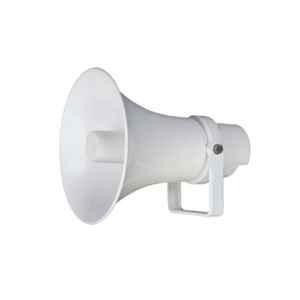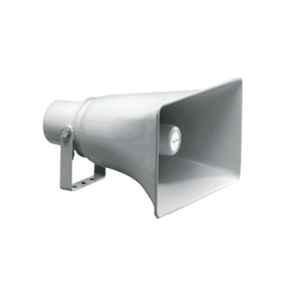


A high-quality horn speaker offers a loud and clear voice over long distances through the PA system. Its selection should be done carefully, considering major factors like cabinet durability, power rating, line voltage, impedance, and more. The most common mistake people make when selecting one is choosing the horn speaker with the highest wattage as per its specs. Instead, they should check its compatibility with the entire system. A speaker should also offer sufficient output to produce a loud and clear voice for live announcements and to broadcast recorded messages. This blog is crafted as a smart buying guide to help you understand the right way of choosing the best horn speaker for PA systems.
What is a Horn Speaker?
A horn speaker is an electronic audio device that produces loud and clear sound from a vibrating driver. It uses a flared acoustic duct known as a horn to amplify the sound signals in a specific direction. The device is most commonly used in PA systems and commercial spaces for clear voice to reach long distances and let people understand speech. Generally, these loudspeakers can reach high volume levels of 105 to 112 decibels when one watt of power is supplied over the distance of one meter.
Major Applications of Horn Speakers
Manufacturing Plants and Steel Mills
These industrial spaces have large machinery that produces loud noises and makes communication difficult. They source horn speakers to boost the sound signals and make loud announcements for the workers to listen.
Logistics Hubs and Warehouses
Logistics hubs and warehouses have large spaces to store stock and cargo with narrow aisles. Their PA systems use horn speakers, as they produce high-volume announcements over long distances.
Parking Lots and Railway Yards
Announcements on large open land require higher-volume sound signals, which normal speakers cannot produce. Only commercial-grade horn speakers are reliable in such scenarios.
Transit Terminals
Public places like bus and railway stations use PA systems with horn speakers to make instant announcements for declaring the late arrivals of buses and trains and changes in their schedules.
Head to Head Comparison Between Horn vs Column vs Ceiling Speaker
| Parameter | Horn Speaker | Column Speaker | Ceiling Speaker |
| Purpose | Long range paging and emergency alerts | Paging and background music | Indoor music and paging |
| Efficiency | Very high | Moderate | Standard |
| Best Use | Factories, yards, outdoor spaces | Corridors, halls, stations | Offices, shops, hotels |
| Sound Direction | Narrow and focused sound | Wide horizontal coverage | Wide, even coverage |
| Music Quality | Low | Medium to high | High |
Selecting Right Horn Speaker for Various Environments
| Environment Type | Typical Noise Level | Target Sound Level | Recommended Horn Power |
| Quiet Warehouse or Yard | 55-65 decibels | 75-80 decibels | 6-10 Watts |
| Assembly Line or School Ground | 68-78 decibels | 88-93 decibels | 15-30 Watts |
| Machine Shop or Traffic Hub | 80-92 decibels | 95-105 decibels | 30-50 Watts or higher |
Selecting Weatherproof Horn Speakers for Indian Climates
PA systems that are installed outdoors face harsh environments, with rain and dust damaging different parts. In such conditions, regular home speakers can fail easily, but commercial speakers come in different IP (Ingress Protection) ratings. Here is what different ratings mean:
IP55: Speakers with this IP rating are protected against dust accumulation and water jets coming from any direction. They remain functional in outdoor environments with moderately harsh conditions.
IP65: This rating means the device is dust-tight and completely protected from heavy rain and water sprays. It is best for speakers installed near pool areas and rooftops.
IP66 or IP67: The highest rating a speaker device can get. They are protected completely from powerful water jets and regularly deposited dust.
Factors to Consider for Buying Right Horn Speaker for PA System
| Selection Factor | General Values | Application |
| Wattage | 15W-50W | Factories, warehouses, and campuses |
| Sound coverage | 100-500 meters (based on conditions) | Large outdoor areas |
| Weather resistance | IP65 or higher | Outdoor installations |
| Sound pressure level (SPL) | 100-120 dB | Noise industrial areas |
| Impedance | 4Ω–16Ω or 70V/100V line | PA systems and public announcements |
| Frequency response | 300 Hz- 8 kHz | Voice announcements and emergency alerts |
| Installation | Wall, pole, or bracket mounting | Open yards, entrances, and building exteriors |
| Primary use | Long range sound projection | Emergency paging, security alerts, and public announcements |
Conclusion
Choosing the right horn speaker for a PA system depends on various factors like installation area, noise level, power requirement, and durability. You must check all the specs of the speakers and their compatibility with your existing audio system. It should support amplifiers and have the right IP rating for outdoor use. Finalize your choice based on the intended application and real output.