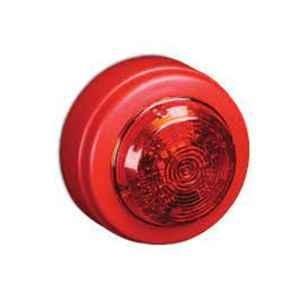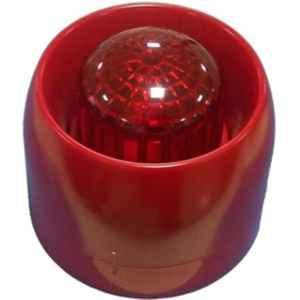


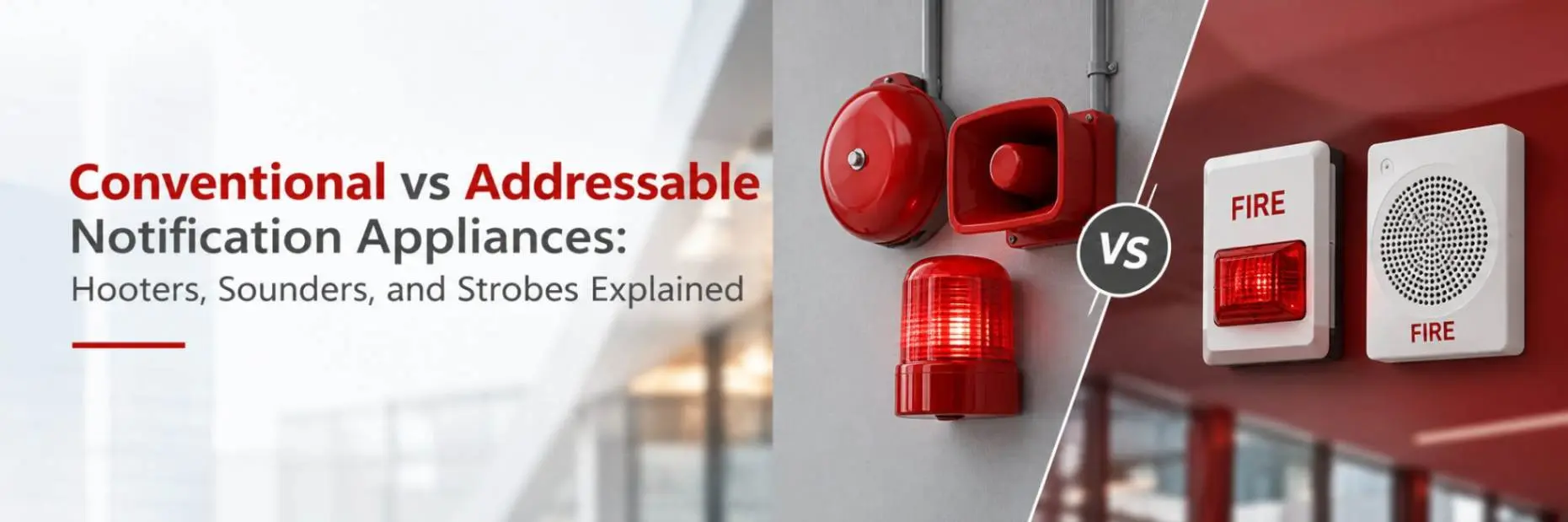
A reliable fire safety system is not just about heat or smoke detectors. During a fire breakout or any other emergency situation, the system must alert the occupants instantly to take appropriate safety measures. In this situation, fire safety notification appliances play a vital role. They produce both visible and audible warnings for people to evacuate early to a safe location. Such notification appliances include horns, hooters, strobes, sounder strobes, and more.
There are both conventional and addressable notification appliances used in fire alarm systems. The purpose of both devices is the same: to alert people about emergencies. However, their installation, connectivity, monitoring, and working differs a lot. This blog reveals all about conventional and addressable notification appliances, including major differences, types, benefits, features, and what you should choose.
What are Fire Alarm Notification Appliances?
Fire alarm notification appliances are audible and visible notification devices that alert the occupants to evacuate buildings during emergencies. These devices produce high-pitched sounds that can be heard over large distances and flashing lights to quickly grab the attention of people. Without these appliances, there would be a significant delay in informing occupants about emergency situations. Manufacturers offer both conventional and addressable notification appliances. While conventional devices are for small-scale systems and have zone location tracking, addressable devices are easy to scale for large sites and offer precise location tracking with unique addresses.
Fire alarm notification appliances include:
- Horns or Hooters: Produce a loud alerting sound.
- Sounders: Generate high pitch electronic alarm tones.
- Strobes or Beacons: Produce a flashing light.
- Horn-Strobes: Combination of horns and strobes for both visible and audible alerts.
- Sounder Strobes: Combines electronic sounder with strobe in a single unit.
- Speakers: Provides voice alerts to the occupants and life saving instructions during emergencies.
What is a Conventional Notification Appliance?
A conventional notification appliance is a wired device that is directly connected to the fire alarm control panel and activates when the panel sends the signal. These devices do not have a unique digital ID for the panel to track their exact location, but they can help to track their installation-specific zone. As they are hardwired to the panel, their reliability surpasses that of addressable notification devices.
Key Features of Conventional Notification Appliances:
| Characteristic | Simple Meaning |
| Circuit-based operation | Devices activate through a shared notification circuit. |
| Simple installation | Requires straightforward wiring and setup. |
| Easy configuration | Simple to connect and configure with the fire alarm panel. |
| Suitable for smaller systems | Works well in small or less complex buildings. |
| Basic diagnostics | Faults are generally identified at the circuit level rather than for each device. |
What Is an Addressable Notification Appliance?
An addressable notification appliance is a fire alarm device that produces visible or audible alerts for occupants to evacuate early. Unlike conventional devices, these appliances have a unique digital ID, allowing the control panel to track the precise device location. When the fire detectors send a signal to the control panel about a fire outbreak, the panel activates the connected notification appliances. Addressable devices can be connected wirelessly, making large-scale project installation easy and low maintenance.
Key Features of Addressable Notification Appliances:
- Individual device identification
- Selective activation
- Detailed diagnostics
- Electronic supervision
- Easier fault identification
- Programmable operation
- More flexible system configuration
What’s the Difference Between Conventional and Addressable Notification Appliances?
Here’s the detailed table to understand the major difference between the two different technologies
| Feature | Conventional | Addressable |
| Device Identification | Circuit or zone level | Individual device level |
| Control | Circuit-based | More selective control |
| Wiring | Dedicated notification circuits | Addressable system architecture |
| Diagnostics | Circuit-level information | Detailed device-level information |
| Installation | Simpler | More system-dependent |
| Configuration | Basic | More programmable |
| Initial Equipment Cost | Generally lower | Generally higher |
| Best Suited For | Smaller systems | Larger or more complex systems |
So, Which Should You Choose: Conventional or Addressable Notification Appliances?
Both conventional or addressable notification appliances have their perks and limitations. Neither of the technologies becomes automatically better, and the right choice depends on the scale and intensity of the project.
Here’s when you should choose conventional notification devices:
- The installation is relatively small.
- Simple circuit-based notification is sufficient.
- The project has limited notification zones.
- A conventional fire alarm infrastructure is already installed.
- Simple maintenance and configuration are priorities.
Here’s when addressable notification appliances are the ideal:
- The installation is large or complex.
- Individual device identification is important.
- Detailed diagnostics are required.
- Selective notification is needed.
- The system requires advanced programming.
- Future expansion and system flexibility are important.
Conclusion
Conventional and addressable notification appliances are the right choice depending on the project site and scale of the system. Both technologies are designed to meet the specific requirements of a fire alarm system. In the end, both types of devices alert occupants to evacuate the building during emergencies. A major difference between the two is how they communicate with the system and are controlled by it. Conventional devices are best for simpler installations and small-scale projects. Whereas, the addressable devices offer accurate location tracking and are easy to scale up for large projects.