

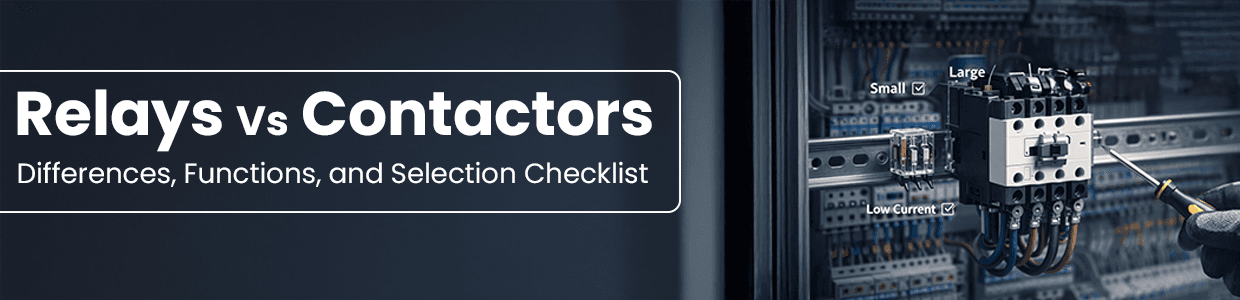
Relays and contractors are both electromagnetic switches that help to control a separate high-power circuit by sending low-powered signals. The major difference between them is defined by their capacity to handle electrical loads. Where relay switches are for the low power circuits, specifically 10A or lower, the contactor switches are used for handling high-powered circuits of above 10A. These switches allow the users to control and operate different functions in the equipment or machinery. They have varying characteristics to be used in different types of circuits. Relays are more compact and space-saving than contactors, but they are more delicate and have lower durability. The contactors are designed to power up different functions of heavy-duty machinery and can easily handle heat and rough use. To understand the major difference between these two switches, you will need to carefully assess their functions, benefits, and uses. Let’s discuss them in detail.
What is a Relay Switch?
A relay switch is an electrical component used in a device or equipment to control high power circuits by sending low powered signals. Commonly, they are used for controlling specific functions in a device or to control entire systems. It works when the electromagnet energizes, triggering a mechanical movement of contacts. This movement completes or breaks the circuit and allows the low powered signals to command high power loads including water pump and motors.
How Do Relay Switches Work?
- Low Power Signal: A low power signal is sent to the circuit.
- Electromagnet: Current flow through the coil creating a magnetic field.
- Mechanical Action: The electromagnet triggers a mechanical function which completes the circuit for the device to function.
Major Benefits of Using Relays in Electrical Circuits
Circuit Isolation
Relays are mostly preferred for their safety function, which isolates the control switch from the main load circuit. It allows the operators or technicians to perform repair and maintenance tasks without worrying about electrical hazards. Also, the isolation works best for the low voltage components by preventing them from high voltage surges and major fluctuations. For the clear understanding, the control switches or lower circuits work around 5V and the main load circuit may carry around 220 V, which calls for these safety features.
Helps to Control High Power Circuits
These switches allow the technicians to design machinery with high load features to be controlled using low-power signals. These components make it easy to control heavy machinery in the safest way possible and isolate the circuits to protect other circuits from a faulty one. This benefits by eliminating the need for expensive components that can handle heavy loads to control the heavy-duty machines and equipment.
Remote Control and Automation
Relay switches control heavy-duty machines from a distance remotely. They can be integrated with wireless modules like Bluetooth or Wi-Fi, which allows the workers or operators to control heavy machinery from a distance. They can turn them on or off and even control specific isolated circuits to manage some features. Moreover, there are magnetic relay switches that allow remote control and automation of heavy machinery over long distances.
Durable and Provide Safety
These switches are made using durable materials so that they can handle electrical loads and have a long lifespan. They make the electrical circuits safe to control, as only a 5V signal can activate a 220V load, needing machinery or a function in a system. These abilities protect the operators from activating high voltage manual switches, which have the potential to cause an electrical hazard.
What is a Contactor?
A contactor is also an electromagnetic switch that uses low-power signals to activate high-load functions in machinery or an entire system. They can safely allow an operator to remotely activate a heavy-duty machine without the need for using manual switches, thereby increasing the chances of electrical hazards. Unlike the relays, the contactors are designed to handle heavy electrical loads and can be directly installed in a high-load circuit to control functions.
Major Benefits of Using Contactors
Can Handle High Electrical Loads
Contactors are designed to handle high voltages and are installed in heavy-duty commercial and industrial machinery systems. They use low-power signals to activate some functions in machinery and allow it to turn on or off equipment. They are installed in the electrical systems based on the total electrical load and control requirements.
Protects Operators
Contactors also allow the operators to control machinery from a distance by sending low-voltage signals. This eliminates the chances of using manual switches and coming in direct contact with high voltage flowing through them.
Energy Efficient
Contactors that have electronic coils can help you reduce the power consumption by 80 percent, which will let you save big on electricity bills. They are highly energy-saving as they use low-voltage signals to activate the high-load circuits and also have a low upfront cost in the market.
Durable and Cost Saving
Contactors are designed using durable materials to deliver high performance over a long time period. They not only handle heavy electrical loads efficiently but also don’t require frequent replacements, which saves a lot of operational cost.
Major Difference Between Relays and Contactors
| Basis | Relays | Contactors |
| Purpose | Used to control low-power circuits | Used to control high-power circuits |
| Current Rating | Handles small current loads | Handles high current loads |
| Applications | Used in control panels and electronics | Used in motors and heavy machinery |
| Size | Small and compact | Larger and more robust |
| Contact Design | Light-duty contacts | Heavy-duty contacts with arc control |
| Safety Features | Limited safety protection | Built-in arc suppression and safety features |
| Common Use | Signal switching and automation | Industrial power switching |