

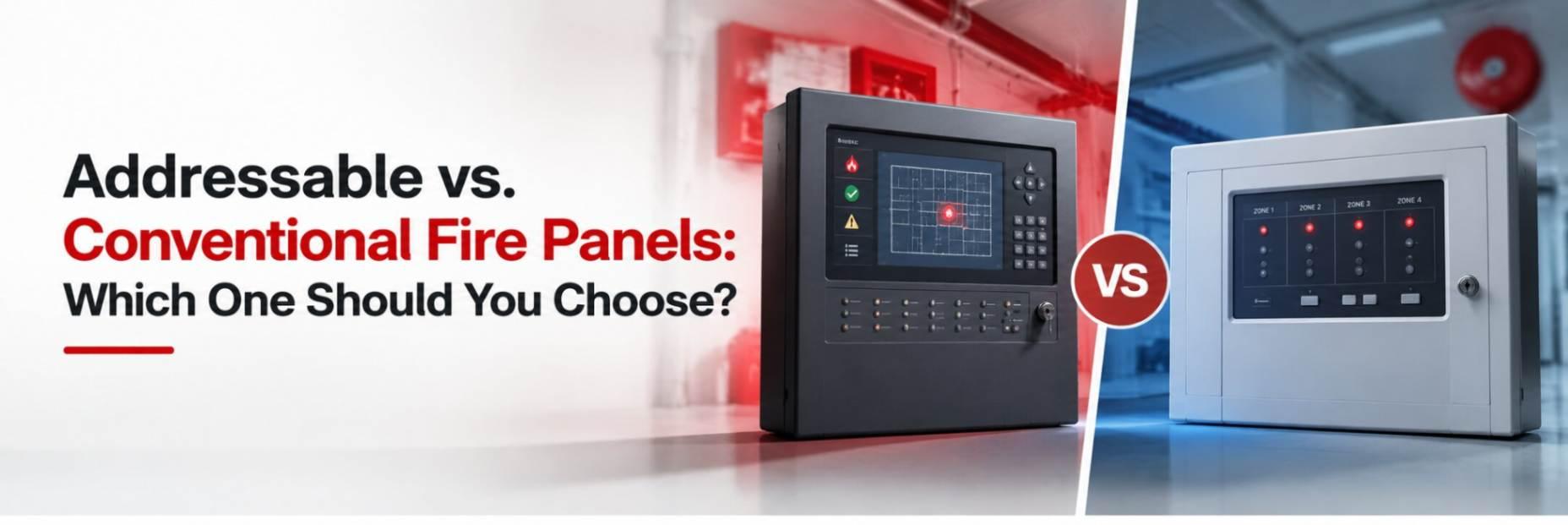
The selection between an addressable and conventional fire panel can’t be finalized just by analyzing how affordable and advanced it is. Both systems are efficient depending on the safety needs and architecture of the fire safety system in a building. They offer high performance and are reliable when installed accurately, tested regularly, and maintained properly. However, the real difference between the fire panels is clearly understandable when it comes to how much information they can process, how easily they can detect faults, the level of scalability they offer, and how well they fit the building’s architecture.
So, which one should you choose? This blog answers this question by providing a side-by-side comparison of both fire panels, explaining how they work, and discussing many other factors.
What is a Conventional Fire Panel?
A conventional fire panel is a hardware device used in fire safety systems to divide the protected space into different zones. It is connected to all the fire detection and notification devices installed within a zone. These panels play a vital role and help identify which zone the detector has activated the fire alarm signals, but can’t point out exactly which device has activated.
How Does a Conventional Fire Panel Work?
A conventional fire system divides the protected space into different zones, with each one having a dedicated panel.
Here’s how the conventional system works:
Detector > Zone Circuit > Fire Alarm Panel > Alarm/Notification
For example, a building could be divided into:
- Zone 1 – Ground Floor
- Zone 2 – First Floor
- Zone 3 – Second Floor
- Zone 4 – Basement
So, if the detector installed on the second floor activates, the panel will show Zone 3.
Its working shows how simple and easy to operate a conventional system is. With high precision, the system is reliable and easy to maintain.
Using a Conventional Fire Panel is Ideal When:
- The space is relatively small.
- There are a limited number of zones.
- The building layout is straightforward.
- Each zone is easy to manage.
- The exact location of the device is not essential.
- The space requires a simple system with a low budget and operational cost.
What is an Addressable Fire Panel?
An addressable fire panel is a fire safety system device that communicates with devices individually and identifies their location with precision. It does not work by dividing the protected area into different zones; instead, every connected device sends its unique address along with signals to the panel for identification and status monitoring. Every device in an addressable fire safety system, such as manual call points, detectors, sensors, and more, has a unique address, which it reports when reporting an alarm or fault for quick response.
How Does an Addressable Fire Panel Work?
Addressable fire safety systems are more reliable and responsive with immediate response, device location tracking, and other automatic operations.
An addressable fire panel does not identify a collection of devices as a single zone. The compatible devices are assigned unique addresses which are communicated while sending signals to the panel.
Here’s how the addressable fire panel works:
Individual Device > Addressable Loop/SLC > Fire Alarm Panel > Alarm/Control Response
Types of information addressable technology shares based on the system:
- Individual device alarm status
- Device fault conditions
- Device supervision
- Event history
- Programmable cause-and-effect functions
- Detailed system diagnostics
- Interfaces with other fire and building systems
A Side by Side Comparison of Addressable Vs Conventional Fire Panels
| Factor | Conventional Panel | Addressable Panel |
| Alarm identification | Zone level | Individual device/point |
| Basic architecture | Zone-based circuits | Addressed SLC/loop architecture |
| Initial equipment cost | Generally lower | Generally higher |
| Wiring approach | Separate circuits for zones | Devices can share signaling loops |
| Fault identification | Primarily circuit/zone level | Can identify individual devices |
| Troubleshooting | More physical investigation | More detailed panel diagnostics |
| Expansion | Depends heavily on spare zone capacity and wiring | Often more flexible within loop/panel capacity |
| Programming | Relatively simple | More extensive programming possible |
| Event information | Basic | More detailed |
| System integration | Possible, depending on equipment | Often supports more sophisticated interfaces |
| Best suited to | Smaller, simpler installations | Larger or more complex installations |
| Main advantage | Simplicity and lower entry cost | Information, flexibility and scalability |
When Should You Choose a Conventional Fire Panel?
A conventional fire panel should be procured for the system installed in limited space requiring a straightforward safety system.
Here’s when you should opt for conventional systems:
- Maintenance staff are familiar with zone-based systems.
- Clearly separated areas make zone identification practical.
- Local technicians can easily service the system.
- The installation has stable and predictable requirements.
- Frequent system reprogramming is unlikely.
- Extensive proprietary programming is unnecessary.
- Detailed device-level diagnostics offer limited value.
- Few complex system integrations are required.
- When should you choose an Addressable Fire Panel?
Addressable systems are more complex and require proper planning before installation to make it future proof.
Here’s when should opt for it:
- Detailed event history is valuable.
- Device-level fault reporting is needed.
- Remote monitoring is required.
- Individual device settings are important.
- Preventive maintenance is a priority.
- Complex control logic is required.
- Multiple functions need coordinated control.
- Recurring faults need easier diagnosis.
- Detailed system diagnostics are important.
So Which Fire Panel Should You Choose for Your Space: Conventional or Addressable
There is no definite answer to this question, but here are the certain conditions in which the choice becomes obvious:
| If Your Main Requirement Is: | Consider |
| Simple system architecture | Conventional |
| Lower initial equipment cost | Conventional |
| Small and straightforward premises | Conventional |
| Limited number of zones | Conventional |
| Individual device identification | Addressable |
| Detailed fault information | Addressable |
| Large number of devices | Addressable |
| Multi-floor/complex building | Addressable |
| Advanced programming and integration | Addressable |
| Greater future flexibility | Addressable |